
Dyslexia Is So Much More Than Struggling to Read
One of the things I hear most often from parents who come to us is some version of this: "But she reads fine. Her teacher said she couldn't have dyslexia." And I understand why that is confusing. The word dyslexia has become so closely linked with reading difficulties that when a child is managing to decode words on a page — even slowly, even with tremendous effort — parents and teachers can rule it out entirely
But dyslexia is not just a reading problem. And until we start talking about it more honestly, a lot of children are going to continue struggling in ways that nobody can quite explain.
What Dyslexia Actually Is
Dyslexia is a difference in how the brain processes language. It affects the ability to connect sounds to letters, to hold sequences of information in working memory, and to retrieve words quickly and accurately. Reading is often where this shows up first — because reading requires all of those skills at once — but the impact stretches much further than a book.
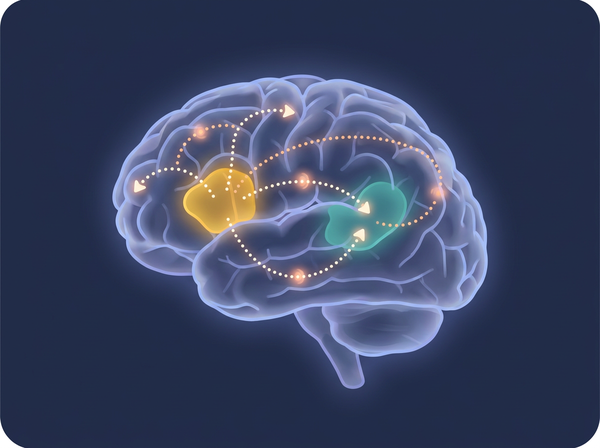
Dyslexia affects the language processing areas of the brain
A child with dyslexia might read reasonably well by the time they are nine or ten, having worked incredibly hard to compensate. But that same child might struggle to follow multi-step instructions, forget what they were about to say mid-sentence, take three times as long to copy from the board, or find spelling consistently baffling no matter how much they practise.
The reading has improved. The dyslexia has not gone away.
The Signs That Often Get Missed
In clinic, we see the same patterns over and over again in children whose dyslexia was not picked up — or was dismissed — at school. These are some of the signs worth knowing about.
Slow processing speed is one of the biggest ones. Your child understands the material. They know the answer. But by the time they have translated their thoughts into written words, the lesson has moved on. Teachers can mistake this for disengagement or low ability. It is neither.
Difficulty with sequences — days of the week, months of the year, tables — is another classic indicator. So is struggling with rhyme, or finding it hard to find the right word when speaking even though the knowledge is clearly there.
Fatigue is underrated as a symptom. Children with dyslexia often spend so much mental energy compensating for their processing differences that by the afternoon, they are exhausted in a way their classmates simply are not. School is hard work when your brain is working against you at every step.
Why Compensating Is Not the Same as Coping
Here is something I want parents to understand: a child who appears to be managing is not necessarily a child who is thriving. Many bright dyslexic children become extraordinarily good at hiding their difficulties. They develop workarounds. They copy from a friend. They choose simple words they know how to spell instead of the interesting ones they want to use. They stay quiet rather than risk getting it wrong.
This takes a toll. The anxiety, the loss of confidence, the sense of being "stupid" in a world that has not been designed for how their brain works — these things build up quietly over years.
A formal assessment does not just tell you whether your child has dyslexia. It tells you exactly how their brain is working, where the barriers are, and what kind of targeted support will actually make a difference.
What a Learning DNA Assessment Looks Like
When a child comes to us for a 360 assessment, we are not just testing their reading age. We look at the whole picture — processing speed, working memory, phonological awareness, verbal reasoning, and more. We look at what is happening beneath the surface, not just what is visible in the classroom.
Parents regularly tell us they leave feeling like they finally understand their child. That they have been given a language for something they always suspected but could never quite name.
That clarity changes things. It changes how you advocate for your child at school. It changes how your child sees themselves. And it gives us the foundation to put real, evidence-based support in place.
What to Do Next
If you recognise any of this in your child — or if your gut has been telling you something is not quite right even when everyone else says they are fine — please do not wait. The earlier we understand how a child's brain works, the earlier we can help.
Book a free 15-minute consultation with us at https://www.learningdna.org.uk/book-a-consultation . There is no pressure and no commitment. Just a conversation about your child, and what might help.